Silicon Metal Prices Continue to Decline, Market Slump Difficult to Break [SMM Analysis]

Published: Mar 11, 2025 17:03
Source: SMM
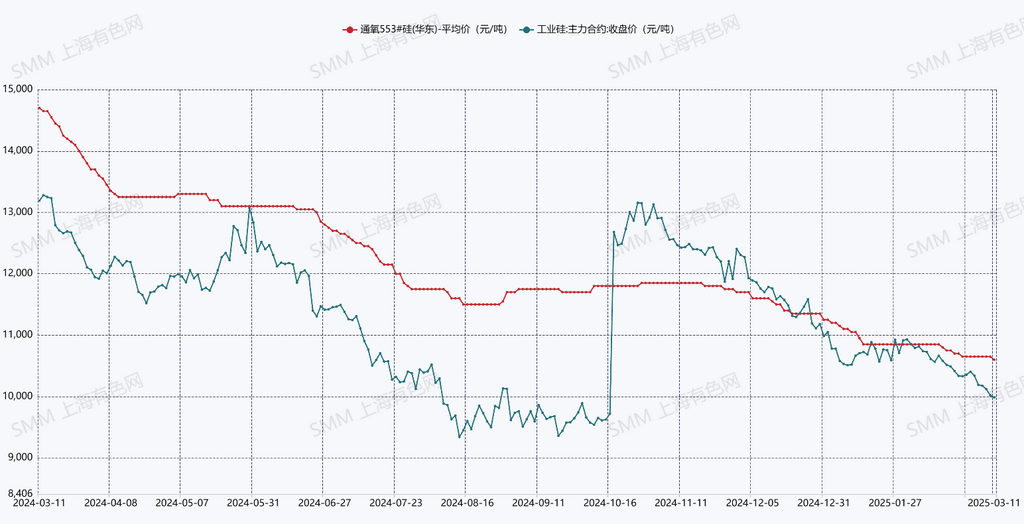
[SMM Silicon Market February-March Brief: Silicon Metal Prices Continue to Decline, Market Slump Difficult to Break] From February to early March, spot silicon metal maintained a weak trend, with SMM east China above-standard #553 silicon down 250 yuan/mt, a decrease of 2.3% MoM. While spot prices remained weak, futures prices also fell to new lows after implementing new standards. On March 11, the most-traded Si2505 futures contract officially dropped below 10,000 yuan/mt, closing at 9,985 yuan/mt, down 805 yuan/mt or 7.5% MoM. The sharp decline in silicon metal futures prices, along with the inflow of warehouse warrants and non-standard supplies into the market, accelerated the drop in spot silicon metal prices, with pessimistic and negative market sentiment proving difficult to reverse.

SMM March 11 News: From February to early March, spot silicon metal continued its weak trend. SMM east China above-standard #553 silicon fell by 250 yuan/mt MoM, a decrease of 2.3%. While spot prices remained weak, futures prices also dropped to new lows after implementing the new standard. On March 11, the most-traded Si2505 futures contract officially fell below 10,000 yuan/mt, closing at 9,985 yuan/mt, down 805 yuan/mt MoM, a decrease of 7.5%. The sharp decline in silicon metal futures prices, along with the influx of warehouse warrants and non-standard cargoes into the market, accelerated the drop in spot silicon metal prices, with market sentiment remaining pessimistic and difficult to reverse.

Supply: According to SMM data, silicon metal production in February 2025 was 289,500 mt, down 14,500 mt MoM, a decrease of 4.8%. Based on daily average production, February's average daily output was higher than January's. By province, silicon enterprises in Xinjiang, Inner Mongolia, and Gansu showed relatively high operating rates, with the combined supply from these three regions accounting for over 80%, while Sichuan and Yunnan accounted for less than 6%. In March, with the production release from newly resumed silicon furnaces and the expected resumption of production by some silicon enterprises, coupled with an increase in production days, silicon metal production in March is expected to increase significantly, reaching over 340,000 mt.

Demand: SMM data shows that the operating rate of the polysilicon industry fluctuated slightly from February to March. Polysilicon production in February was 90,100 mt, and March production is expected to reach 94,600 mt. By April-May, monthly polysilicon production may increase to 110,000 mt. Silicone enterprises experienced a significant decline in operating rates in February, with silicone DMC production at 199,500 mt, down 9.6% MoM. Operating rates in March are expected to remain relatively stable. The decline in production was driven by proactive maintenance of some silicone monomer capacities, reducing demand for silicon metal. For silicone, the decrease in DMC production, combined with restocking during the downstream "mini peak season," pushed silicone product prices upward, significantly improving the profitability of the silicone industry. The operating rate of the aluminum-silicon alloy industry gradually returned to normal levels from February to March.

Bullish Factors: Improved profitability of silicone enterprises

Bearish Factors: Increased supply from resumed capacities of northern silicon metal producers, new existing capacities awaiting commissioning, difficulties in inventory destocking, and weak price trends for silicon coal as a raw material

SMM Viewpoint: Based on supply-demand balance calculations, the industry experienced slight destocking in January-February. However, with the increase in operating capacity and significant production growth on the supply side in March, coupled with minimal demand growth, the balance is expected to shift back to surplus in March. Polysilicon enterprises have relatively large supporting silicon metal capacities, with large-scale silicon enterprises (annual capacity of 100,000 mt or more) accounting for a higher proportion of supply and offering greater supply stability compared to small and medium-sized enterprises. The fundamental outlook for silicon metal remains strong supply and weak demand. Even if some small and medium-sized enterprises implement production cuts, it will be difficult to change the current supply-demand situation. Spot silicon metal prices are expected to remain at low levels in the near term.

For more detailed market information and updates, or if you have other inquiries, please call 021-51666820.


Data Source Statement: Except for publicly available information, all other data are processed by SMM based on publicly available information, market communication, and relying on SMM‘s internal database model. They are for reference only and do not constitute decision-making recommendations.

For any inquiries or to learn more information, please contact: lemonzhao@smm.cn
For more information on how to access our research reports, please contact:service.en@smm.cn
Related News
Macro Sentiment Suppressed Futures, Stainless Steel Profits Narrowed Amid Raw Material Divergence [SMM Analysis]
3 mins ago
Macro Sentiment Suppressed Futures, Stainless Steel Profits Narrowed Amid Raw Material Divergence [SMM Analysis]
Read More
Macro Sentiment Suppressed Futures, Stainless Steel Profits Narrowed Amid Raw Material Divergence [SMM Analysis]
[SMM Analysis] Macro Sentiment Weighed on Futures, Stainless Steel Profits Narrowed Amid Raw Material Divergence Stainless steel production costs pulled back this week, and steel mill profits narrowed, with profit divergence driven by differing raw material inventory costs. Using 304 cold-rolled as the calculation benchmark, the profit margin based on current raw material costs was 1.87%, while the profit margin based on low-level inventory raw material costs was 4.48%. Overall industry profitability remained moderate, steel mills maintained high production schedules, and operating rates stayed stable. Nickel-based raw material costs: Nickel-based raw material prices came under pressure this week, largely driven by futures sentiment. SHFE nickel and stainless steel futures declined consecutively, pulling high-grade NPI market prices down in tandem. However, cost support in the NPI industry remained strong, with widespread firm-pricing sentiment across the market. Additionally, high-grade NPI sources with higher nickel content were scarce within the industry, resulting in structural price divergence in NPI, with prices for high-grade NPI above 12% grade remaining firm. As of this Friday, mainstream 10-12% grade high-grade NPI fell 6 yuan per nickel unit, closing at 1,145 yuan/nickel unit. Stainless steel scrap market: Stainless steel scrap prices pulled back this week. SS futures trended weaker, dragging spot prices lower in tandem. Although high-grade NPI also declined, the drop was limited, highlighting the cost advantage of stainless steel scrap. Steel mill smelting profits remained moderate, production schedules stayed high, and procurement demand remained solid. The overall picture showed "weak futures, resilient raw materials...
3 mins ago
[SMM Stainless Steel Daily Review] Macro Disturbances Dragged Down SS Futures, Low Inventory Pressure and Rigid Demand Supported Stainless Steel Spot Prices
3 hours ago
[SMM Stainless Steel Daily Review] Macro Disturbances Dragged Down SS Futures, Low Inventory Pressure and Rigid Demand Supported Stainless Steel Spot Prices
Read More
[SMM Stainless Steel Daily Review] Macro Disturbances Dragged Down SS Futures, Low Inventory Pressure and Rigid Demand Supported Stainless Steel Spot Prices
[SMM Stainless Steel Daily Review] Macro Disturbances Dragged Down SS Futures, Low Inventory Pressure and Rigid Demand Supported Stainless Steel Spot Prices
[SMM Stainless Steel Daily Review] Macro Disturbances Dragged SS Futures Lower; Low Inventory Pressure and Rigid Demand Supported Stainless Steel Spot Prices SMM, May 15 — SS futures continued to be in the doldrums. Non-ferrous metal futures extended the previous day's decline, and SS also fluctuated downward in tandem. As of the morning close, the most-traded SS contract was quoted at 14,825 yuan/mt. Spot market side, dragged by the persistently weak SS futures, stainless steel spot prices pulled back in tandem. However, stainless steel social inventory has been on an overall downward trend recently, and traders faced relatively small shipment pressure. Market confidence remained stable, and price declines were relatively limited. The most-traded SS contract fell and pulled back. At 10:15 AM, SS2605 was quoted at 14,890 yuan/mt, down 60 yuan/mt from the previous trading day. Spot premiums for 304/2B in the Wuxi area were in the range of 380-680 yuan/mt. In the spot market, the average price of cold-rolled 201/2B coils in Wuxi remained flat; for cold-rolled untrimmed 304/2B coils, the average price in Wuxi fell 100 yuan/mt, and the average price in Foshan fell 100 yuan/mt; cold-rolled 316L/2B coils in the Wuxi area held steady; hot-rolled 316L/NO.1 coils were quoted stable in Wuxi; cold-rolled 430/2B coils in both Wuxi and Foshan held steady. The stainless steel market was dragged by the weak and volatile futures, with notable downward pressure, but overall spot price declines remained limited, highlighting the divergence between futures and spot. Downstream end-users adopted a cautious wait-and-see stance due to macro uncertainties, with no concentrated restocking observed. However, rigid demand purchases remained solid, and the resilience of rigid demand provided a foundation for spot prices...
3 hours ago
[SMM Steel Market Morning Brief] PBOC: Month-end April broad money (M2) balance reached 353.04 trillion yuan, up 8.6% YoY
8 hours ago
[SMM Steel Market Morning Brief] PBOC: Month-end April broad money (M2) balance reached 353.04 trillion yuan, up 8.6% YoY
Read More
[SMM Steel Market Morning Brief] PBOC: Month-end April broad money (M2) balance reached 353.04 trillion yuan, up 8.6% YoY
[SMM Steel Market Morning Brief] PBOC: Month-end April broad money (M2) balance reached 353.04 trillion yuan, up 8.6% YoY
According to PBoC data, at the end of April, the balance of broad money (M2) stood at 353.04 trillion yuan, up 8.6% YoY. The balance of narrow money (M1) was 114.58 trillion yuan, up 5% YoY. The balance of currency in circulation (M0) was 14.75 trillion yuan, up 12.2% YoY. Net cash injection in the first four months totaled 653 billion yuan.
8 hours ago